Emergency response service (ERS)
The Ship Emergency Response Service from Navalista goes beyond the IACS’
recommendation and is continuously evolving to better meet our clients’ needs. Our arrangements and
procedures also meet the industry guidelines. All vessels, irrespective of whether it is classed
with us,
can enroll on our Ships Emergency Response Service. Reasons to choose us include:
As a ship registers for the ERS with us, all her basic data pertaining to trim, stability and longitudinal strength in damaged conditions are uploaded into our electronic database at our Head Office.
Subsequently, during the establishment phase, this data is validated and is run against a few scenarios to confirm the correctness of the software and data. This part of the establishment phase report is also attached to the ERS Manual as Annexure-II. It is recommended that ship’s deck officers refer to this part frequently, as a real-life casualty may have already been covered in the examples considered. It is likely that the intact condition considered in the example may differ from the real-life condition, but it still would provide some useful information.
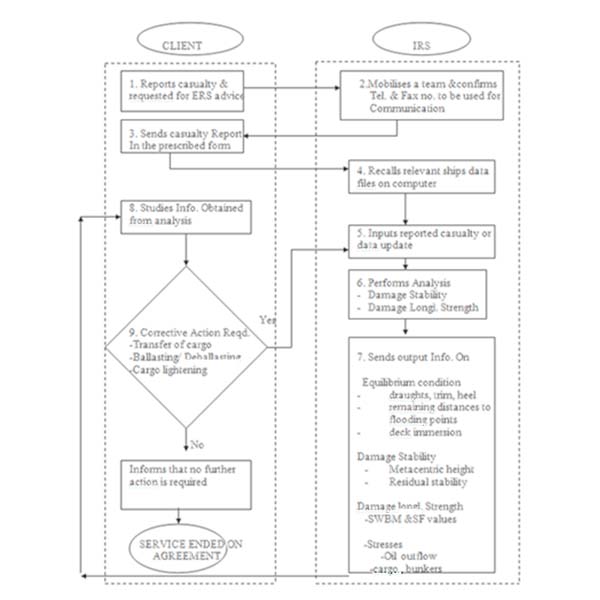
● ● ● In case of an emergency, based on the information provided by the vessel’s Master, Navalista can analyze the ship’s condition using the stored stability information and suggest various options and course of action. The procedure is graphically represented in the flow chart given in Fig. 1 below. The Navalista team will remain available throughout the incident for any re-analysis based on updates to the casualty report form or proposed alternatives and the service shall be ended in agreement with the client.
- We have the technical expertise with relevant experience;
- We can co-ordinate with regulatory authorities who can extend necessary help to your vessel regardless of your ship position;
- We are affordable;
As a ship registers for the ERS with us, all her basic data pertaining to trim, stability and longitudinal strength in damaged conditions are uploaded into our electronic database at our Head Office.
Subsequently, during the establishment phase, this data is validated and is run against a few scenarios to confirm the correctness of the software and data. This part of the establishment phase report is also attached to the ERS Manual as Annexure-II. It is recommended that ship’s deck officers refer to this part frequently, as a real-life casualty may have already been covered in the examples considered. It is likely that the intact condition considered in the example may differ from the real-life condition, but it still would provide some useful information.
● ● ● In case of an emergency, based on the information provided by the vessel’s Master, Navalista can analyze the ship’s condition using the stored stability information and suggest various options and course of action. The procedure is graphically represented in the flow chart given in Fig. 1 below. The Navalista team will remain available throughout the incident for any re-analysis based on updates to the casualty report form or proposed alternatives and the service shall be ended in agreement with the client.
The ERS consists of two phases:
Establishment of a ship under ERS scheme (Phase 1):
Emergency Event Response (Phase 2):
Time frame for ERS would be dependent on how critical the event is based on the request of the client and prompt availability of casualty information. However, the time frame would not exceed 6 (six) hours unless intimated to the clients accordingly.
Establishment of a ship under ERS scheme (Phase 1):
- Establishment of ship's particulars on computer database on receipt of a request from the ship owner. Preparation of the ERS Manual for the ship and handing over the ERS manual to the client.
Emergency Event Response (Phase 2):
- In the event that an emergency event is triggered, an examination of the ship's stability and longitudinal strength in the damaged condition will be carried out on base on the damage report from the client.
Time frame for ERS would be dependent on how critical the event is based on the request of the client and prompt availability of casualty information. However, the time frame would not exceed 6 (six) hours unless intimated to the clients accordingly.